
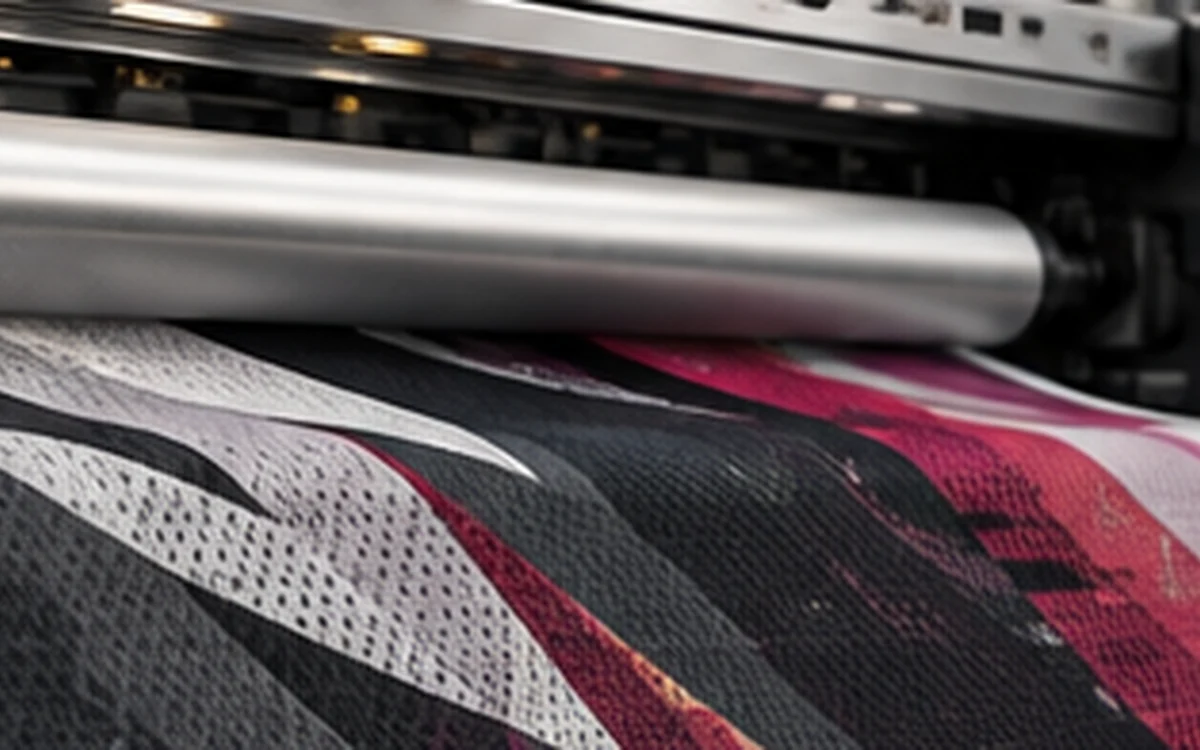
Editorial concept illustration; not an actual T4N product photograph.
A club's identity is more than a crest. Colours, numbers, sponsor marks and the way a design works across a complete kit all contribute to how a team looks together.
Dye sublimation remains a valuable tool for expressing that identity on suitable polyester sportswear. But printing technology is only part of producing a convincing garment.
What sublimation does
In a typical transfer-sublimation process, a design is printed with suitable dyes onto transfer paper. Heat and pressure allow the dye to move into compatible polyester material rather than sitting as a thick surface film.
This makes detailed patterns, gradients and multicolour artwork practical without building the entire design from separate applied pieces.
The garment still has to be engineered
A beautifully printed jersey can fit badly. Print quality cannot correct restrictive underarm geometry, an uncomfortable collar or shorts that move poorly.
At T4N, garment development and club artwork are distinct but connected tasks. The platform is developed for the sport. The design brings the club's identity to it.
Seams are not invisible
Artwork may cross from one pattern piece to another, but the garment is cut, positioned and sewn in the real world. Expecting a complex motif to align flawlessly across every seam, especially highly curved or stretched areas, can create avoidable production problems.
Good artwork considers seam positions, cuffs, hems, panel transitions and any likely manufacturing variation. Sometimes a solid colour transition is the most professional solution.
A designer should understand the intended garment, not merely decorate a flat rectangle.
Colour and fabric need checking
Printed colour can be influenced by substrate, production settings and the way a material receives dye. Printed samples and agreed references matter when club identity depends on a precise shade.
Sublimation is especially relevant to compatible polyester fabrics; it is not the universal answer for every fibre, finish or outerwear requirement.
It isn't automatically an environmental claim
Made-to-order printing can support controlled production planning, but it does not by itself prove a product has a lower overall environmental impact. Waste, energy, transport, material choice and garment longevity need proper evidence before making broader claims.
We would rather explain what the process actually does than attach an unsupported sustainability label to it.
Good custom teamwear is the meeting point of a developed garment, considered artwork and a practical production process.